

From Spend to Sense: How AI Is Redefining Procurement Leadership in Retail & FMCG
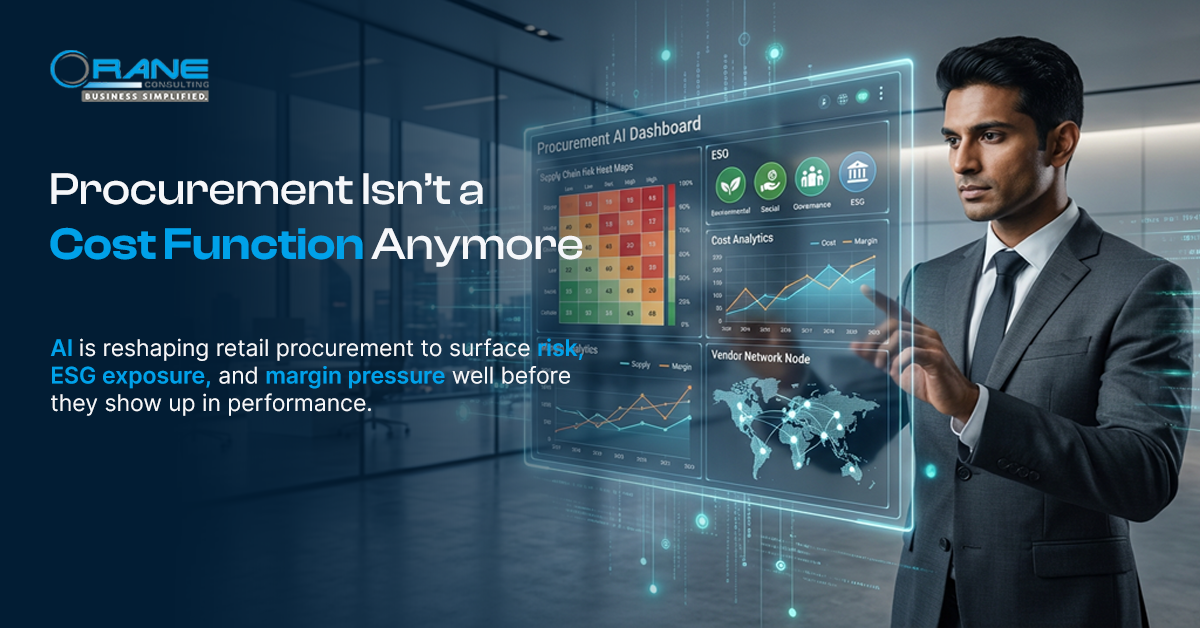
The uncomfortable truth: procurement decisions still arrive late
Most Retail and FMCG Chief Procurement Officers recognise this moment. You are in a leadership discussion. The questions arrive quickly, confidently and without malice.
Why are costs rising in this category when demand is stable?
Which suppliers become fragile if regulations tighten next year?
How defensible are our ESG disclosures beyond Tier-1 suppliers?
And the hardest question of all: are our decisions informed—or merely reactive?
None of these questions are new. What has changed is the expectation behind them. Procurement is no longer evaluated as a cost function. It is assessed as a leadership capability. One that directly shapes margin resilience, brand trust, and sustainability credibility. Yet many procurement organisations are still operating with tools and rhythms designed for a more predictable world.
The gap between managing spends and sensing what is coming next has never been wider.
The modern CPO mandate has expanded quietly, but decisively
Today’s CPO is accountable for far more than negotiated savings. The mandate now includes:
- Margin protection in volatile, promotion-driven markets
- Supplier resilience across extended, multi-tier ecosystems
- ESG delivery embedded directly into sourcing decisions
- Alignment with enterprise planning, finance, and sustainability agendas
Procurement now sits at the intersection of commercial performance, risk, and reputation. However, many teams still rely on operating models built for stability: periodic category reviews, static assumptions, and retrospective reporting. These approaches struggle in environments defined by constant volatility.
Data is integrated. Insight is still fragmented
Retail enterprises have invested heavily in digitisation. ERP cores, supplier networks, analytics layers, and sustainability frameworks are firmly in place.
Spend is visible.
Suppliers are connected.
Performance is measured.
On paper, procurement is data-rich.
In practice, much of this data explains what happened, not what is changing. Risk emerges quietly between reporting cycles. ESG exposure materialises downstream of sourcing decisions. Cost drivers shift before dashboards catch up.
Different systems answer different questions at different speeds. For CPOs, this creates a persistent tension: decisions are made with experience and judgement, but without full situational awareness. This is the gap AI is beginning to close.
Why AI is now a leadership conversation, not a technology one
The AI discussion often starts with efficiency: automation, faster sourcing cycles, productivity gains. Useful, but insufficient.
The real shift is happening because procurement decisions themselves have become structurally more complex.
A single sourcing decision today may be influenced by:
- Demand volatility
- Supplier financial health
- Pricing and commodity movements
- Logistics disruption
- Regulatory pressure
- ESG exposure
These signals live across multiple systems, owned by different teams, and updated at different intervals. AI changes how these signals are processed. Rather than analysing them in isolation, AI continuously connects spend behaviour, supplier performance, contract terms, sustainability data, and external risk indicators. The result is not certainty, but earlier awareness and clearer trade-offs.
For procurement leaders, this marks a transition from explaining outcomes to shaping them.
ESG is no longer downstream. Procurement feels it first.
For many organisations, ESG began as a reporting obligation. That framing is no longer sufficient. The most material sustainability outcomes are determined upstream through supplier selection, category design, and sourcing strategies. In retail and FMCG, Scope-3 exposure, labour practices, and environmental risk extend deep into supplier ecosystems.
Procurement is where ESG becomes real. AI does not “solve” ESG. What it does is make ESG operational:
- Surfacing emerging ESG risk before audits reveal it
- Prioritising supplier engagement based on material impact
- Making trade-offs between cost, resilience, and sustainability explicit
The shift is subtle but critical. ESG moves from being a reporting result to a decision input.
The confidence gap procurement leaders rarely discuss
Privately, many CPOs acknowledge that decision confidence is often partial.
Risk models update quarterly.
ESG data lags reality.
Category assumptions age quickly.
Negotiations rely on incomplete signals.
In volatile markets, the cost of being wrong compounds through margin erosion, supply disruption, compliance exposure, or reputational damage.
AI does not remove uncertainty. It reduces blind spots. It enables procurement leaders to move from asking “What happened?” to “What is changing and where must we act now?” That shift materially alters how procurement shows up at the executive table.
From static category plans to continuous procurement leadership
Traditional category strategies assume relative stability. Retail no longer operates that way. AI enables a continuous sensing model where categories are monitored dynamically for changes in demand, cost drivers, supplier health, and ESG exposure.
Instead of calendar-driven reviews, procurement operates with context-driven focus. Negotiations are prioritised by impact. Supplier strategies adapt earlier. Human judgement remains central but it is supported by timely, connected insight.
This is not automation. It is a new leadership rhythm.
What progressive procurement teams are doing differently
Teams extracting real value from AI share common traits:
- AI initiatives anchored to business outcomes, not experimentation
- Insights embedded directly into sourcing and supplier workflows
- Clear human ownership of decisions and accountability
- Operating models evolving alongside enterprise platforms
AI is treated as decision infrastructure, not a standalone tool.
The question boards now expect procurement to answer
The question is no longer whether systems are in place. It is:
Can procurement sense disruption early enough to act?
Can ESG commitments be delivered without eroding margins?
Can leadership trust procurement’s forward view?
Those who answer “yes” consistently are not just managing spend. They are shaping outcomes and that advantage compounds over time.
The shift from spend to sense has begun.
The only question is whether procurement will lead it or react to it.
Transform your Business the way From Spend to Sense: How AI Is Redefining Procurement Leadership in Retail & FMCG did.
See how Orane helps enterprises solve complex challenges through technology-led transformation.
Lets discuss you Transformation Journey
Whether you are looking to optimize existing systems or embark on a large-scale digital transformation, our experts are ready to help you define the right approach for your business.
