
The Growth Illusion in QSR
In the quick-service restaurant (QSR) industry, growth has often been equated with scale: more outlets, more SKUs, more campaigns. But scale without control doesn’t create value—it breeds complexity.
For Jubilant FoodWorks Limited (JFL)—India’s largest QSR operator, home to Domino’s Pizza, Dunkin’ Donuts, and Hong’s Kitchen—the pressure of rapid expansion created exactly this paradox. Despite its aggressive footprint, the enterprise faced margin erosion, operational blind spots, and delayed decision-making.
The problem wasn’t a lack of ambition—it was a lack of control over a critical choke point: the variance between Ideal Food Cost (IFC) and Actual Food Cost (AFC).
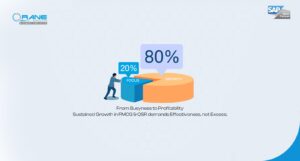
The 80/20 lesson: It’s not the number of stores or SKUs that drives profitability—it’s focusing on the few cost levers that matter most.
CXO Pain Points: Where Growth Was Slipping
- CEO’s — Growth with Margin Stability
Expansion across 1,450+ POS left leadership unable to balance scale with profitability. Fragmented visibility eroded decision confidence. - CFO’s — Profitability in the Dark
Without direct mapping of Actual vs Ideal Food Cost, branch-level profitability was opaque, preventing benchmarking and proactive cost control. - COO’s — Spoilage and Inefficiency
Inefficiencies surfaced too late. Lack of real-time visibility into food costs meant corrective action was often reactive, not preventive.
These challenges reflect broader industry patterns: retail predictability is complex, requiring agile responses and integrated visibility.
Turning Variance into Visibility
The solution came through Orane’s SAP-powered Food Cost Analytics – integrating data across JFL’s network into role-based, persona-driven dashboards.
Executive Dashboard (C-Suite Focus)
KPIs Tracked: Revenue, AFC, IFC, Variance %, AFC/Revenue %, IFC/Revenue %, Top 10 Chains with Max Variance
Enabled leadership to identify non-performing outlets quickly across geographies and timeframes.
Material Dashboard (Operations Focus)
KPIs Tracked: Opening/Closing Stock, Deliveries, Actual vs Ideal Cost by quantity, Variance values Helped managers pinpoint wastage, understand cost drivers, and take timely corrective action.
Business Impact: Hard Numbers, Clear Gains
- 200 bps margin lift through IFC vs AFC control
- Faster decision cycles through elimination of reporting delays across 1,450+ POS
- Significant cost savings from reduced spoilage and optimized supply chain
- Embedded visibility and agility across management and operations.
These results mirror global benchmarks where structured planning drove 20% turnover growth, 30% inventory reduction, and 50% markdown cuts
CXO Playbook: Lessons for QSR Leaders
JFL’s journey offers a blueprint for leaders navigating scale in QSR and retail:
- Benchmark Actual vs Ideal Costs — make variance % a CFO dashboard staple.
- Detect Spoilage and Variance Early — Leverage real-time operational analytics.
- Mobilize Persona Dashboards — CEOs see margin strategy, CFOs see profitability, COOs see efficiency.
- Adopt Disciplined Weekly Planning — Align with IBP best practices
- Prioritize Profitability Before Scale — Fix cost levers before opening new outlets.
Conclusion: Growth Comes From Fixing What Matters
For Jubilant FoodWorks, profitability wasn’t unlocked by opening more stores—it was unlocked by fixing the variance blind spot with SAP-powered analytics.
The 80/20 lesson for every QSR CXO :
- Focus on the 20% of costs that define 80% of profitability.
- Visibility + variance control = resilience and margin discipline.